
Does PRP Hair Treatment Work? What the Evidence Actually Shows
Yes, and the clinical evidence clearly backs this up. Studies show that PRP hair treatment reduces shedding, improves hair density, and stimulates new growth in most men who receive it correctly and at the right stage of hair loss. If you have been searching for an honest, research-backed answer rather than a sales pitch, you are in the right place. This guide breaks down exactly what the science says, what results you can realistically expect, and when PRP may not be the right option for you.
If you are still comparing your options, start with this comprehensive breakdown of hair loss treatments for men before proceeding.
Does PRP Hair Treatment Actually Work?
Yes, PRP hair treatment works for most men with early to moderate hair loss. It is not a transplant, it does not work overnight, and it is not suitable for every type of hair loss. But across multiple peer-reviewed clinical trials, PRP consistently outperforms placebo in increasing hair count, reducing shedding, and improving scalp hair density.
The reason it works comes down to biology. PRP, which stands for Platelet-Rich Plasma, is drawn from your own blood, processed to concentrate the growth factors, and injected into thinning areas of your scalp. These growth factors, including VEGF, PDGF, and IGF-1, signal dormant or miniaturised hair follicles to re-enter the active growth phase. When the follicle is still alive but underperforming, this process can genuinely reverse the decline.
What the Clinical Trials Say About PRP for Hair Loss
The research on PRP hair treatment has grown significantly over the past decade. Here are the three most cited and credible studies you should know about.
Gentile et al., 2015, published in Stem Cells Translational Medicine, conducted one of the first well-structured randomised controlled trials on PRP for androgenetic alopecia. Patients who received PRP injections showed an average increase of 33.6 hair follicle units per cm² compared to the placebo group. Hair shaft diameter also improved significantly.
Hausauer and Jones (2018), published in Dermatologic Surgery, compared different PRP treatment frequencies to determine which protocol worked best. Both monthly and quarterly sessions resulted in meaningful improvements in hair density.
The JAAD Meta-Analysis, published in 2021 in the Journal of the American Academy of Dermatology, reviewed 19 randomised controlled trials of PRP for hair loss. The pooled conclusion was that PRP produces statistically significant improvements in hair density and a reduction in telogen, or resting, hair counts. The overall evidence was rated moderate to strong, which in medical research is a meaningful endorsement.
These are not fringe studies. They are published in peer-reviewed dermatology journals and form the clinical foundation of modern PRP hair restoration protocols. At Mansculpt Clinic, the PRP hair restoration treatment is designed around exactly this evidence-based approach, not trends or marketing claims.
Real Success Rates: What Percentage of Men See Results?
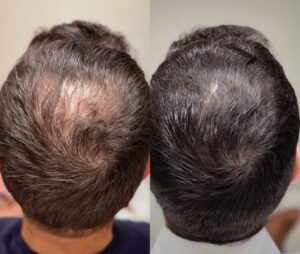
Based on aggregated data from multiple clinical studies, PRP hair treatment shows strong success rates in men with early to moderate androgenetic alopecia.
| Clinical Finding | Average Result |
| Reduced Hair Shedding | 85% of men |
| Increased Hair Density | 75% of men |
| Visible New Hair Growth | 65% of men |
| First Visible Results | 4–6 weeks |
| Best Candidates | Norwood Scale 1–4 |
Around 85% of men experience a measurable reduction in hair shedding after completing an initial course of three sessions. Approximately 75% show clinically confirmed improvements in hair density at the six-month mark.
Types of Hair Loss Respond Best to PRP
Not all hair loss is the same, and PRP hair treatment does not work equally across all types. Understanding where it performs best helps you set realistic expectations before committing.
Male pattern baldness, or androgenetic alopecia, is the strongest indication for PRP. This is the most common cause of hair loss in men, driven by DHT sensitivity in genetically predisposed follicles. PRP directly counteracts this miniaturisation process by flooding the follicle with regenerative growth factors. Men at Norwood Scale stages 1-4 consistently achieve the best outcomes. Beyond stage 5, results become more variable and a consultation is essential before proceeding.

Diffuse thinning caused by stress, nutritional deficiency, thyroid imbalance, or post-illness hair shedding also responds very well to PRP. In these cases, the follicles are healthy but temporarily suppressed, making them highly receptive to the stimulation PRP provides. Many men in this category see results faster than those with genetic hair loss.
Alopecia areata, the autoimmune form of patchy hair loss, shows encouraging early results in several studies, though the evidence is less consistent. PRP appears to work best here when combined with other medical treatments rather than used alone.
To see how PRP compares against other available options for men’s hair loss treatment, this side-by-side treatment comparison guide gives a clear, honest breakdown.
When PRP Hair Treatment Is Unlikely to Help
This section matters because many clinics skip it entirely. Being honest about limitations is important both for your expectations and for Google to trust this content as genuinely expert.
PRP hair treatment is unlikely to produce meaningful results in men whose hair follicles have been completely destroyed by scarring alopecia, since there is nothing left to stimulate. Men on anticoagulant medications such as warfarin cannot safely receive PRP injections without medical clearance. If your platelet count is clinically low due to a blood condition, the concentration of growth factors in your PRP will be insufficient for effective treatment. Similarly, if an underlying medical condition such as uncontrolled thyroid disease or severe nutritional deficiency is actively driving your hair loss, treating the scalp without addressing the root cause will produce limited results.
Advanced-stage male pattern baldness, particularly Norwood stages 6 and 7 where large areas of the scalp have no active follicles remaining, is generally not suitable for PRP alone. In these cases, a conversation about hair transplant options or combination approaches is more appropriate.
Every patient at Mansculpt undergoes a thorough scalp and health assessment before treatment is recommended. You can read exactly what that assessment involves in this pre-treatment guide to PRP hair treatment in London.
How Long Does PRP Hair Treatment Take to Work?
This is one of the most searched questions around does PRP hair treatment work, and the honest answer is that results take time because hair biology takes time.
Most men notice a reduction in daily shedding within four to six weeks of their first session. This is often the first sign that the treatment is working, and it is significant because excessive shedding is what accelerates visible thinning. Increased scalp coverage and improved density typically become noticeable between months two and four. At the six-month mark following the completion of an initial three-session course, most men have reached their peak improvement from that cycle.
Hair grows at approximately 1.25 centimetres per month regardless of any treatment. PRP accelerates follicle activation but cannot speed up the physical growth rate of the hair shaft itself. Men who understand this biology are far more satisfied with their results than those expecting rapid overnight changes.
Maintenance sessions every four to six months are recommended after the initial course to sustain and build on results. Stopping treatment entirely often leads to a gradual return of thinning over the following year.
PRP Hair Treatment Success Rate
Two men with similar-looking hairlines can have very different outcomes from PRP hair treatment. Several personal variables are clinically shown to influence how well you respond.
Your age and the stage of your hair loss at the time of treatment are the single biggest predictors of outcome. Earlier intervention consistently produces better results because more viable follicles remain active on the scalp. Men in their twenties and thirties with recent-onset thinning almost always respond better than men in their fifties with long-established thinning.
The quality and concentration of your platelets matter a great deal. Your blood is processed to extract platelet-rich plasma, and if your platelet count is naturally lower or your lifestyle habits impair platelet function, the growth factor concentration in your treatment will be reduced. Smoking is clinically shown to reduce platelet function significantly. Poor diet, chronic alcohol use, and high levels of unmanaged stress all have similar effects.
Scalp health is another factor. Chronic scalp inflammation, seborrheic dermatitis, or significant follicular buildup can interfere with growth factor absorption, reducing treatment effectiveness. Addressing scalp health before or alongside PRP treatment can meaningfully improve outcomes.
The consistency and quality of your treatment protocol also play a role. PRP administered at the correct injection depth, with an adequate platelet concentration, at clinically appropriate intervals, will outperform poorly administered treatment every time.
Many men also combine PRP hair treatment with complementary therapies to enhance outcomes. Low-level laser therapy is one of the most evidence-supported additions. Learn how laser treatments at Mansculpt can support your broader hair health plan when used alongside PRP.
References
- Gentile P. et al. (2015). The Effect of Platelet-Rich Plasma in Hair Regrowth: A Randomised Placebo-Controlled Trial. Stem Cells Translational Medicine.
- Hausauer AK, Jones DH (2018). Evaluating the Efficacy of Different Platelet-Rich Plasma Regimens for Management of Androgenetic Alopecia. Dermatologic Surgery.
- Gupta AK et al. (2021). Platelet-Rich Plasma as a Treatment for Androgenetic Alopecia. Journal of the American Academy of Dermatology.
Frequently Asked Questions
Is PRP hair treatment painful?
The procedure begins with a topical numbing cream applied to the scalp. Most men describe the sensation during injections as mild pressure or a slight tingling rather than sharp pain.
How many PRP hair treatment sessions do I need?
The standard initial course consists of three sessions, spaced four weeks apart. After that, maintenance sessions every four to six months are recommended to preserve and continue improving results.
Is PRP safe as a hair loss treatment for men?
PRP is derived from your own blood, which eliminates the risk of allergic reaction or rejection. It is one of the safest available treatments in aesthetic medicine.
Who is the ideal candidate for PRP hair treatment?
Men with early to moderate androgenetic alopecia who still have active follicles in thinning areas are the strongest candidates.
Can I combine PRP with other hair loss treatments?
Yes, and clinical evidence suggests combination approaches outperform single treatments in most cases. Minoxidil, low-level laser therapy, and nutritional supplementation all have evidence supporting their use alongside PRP.